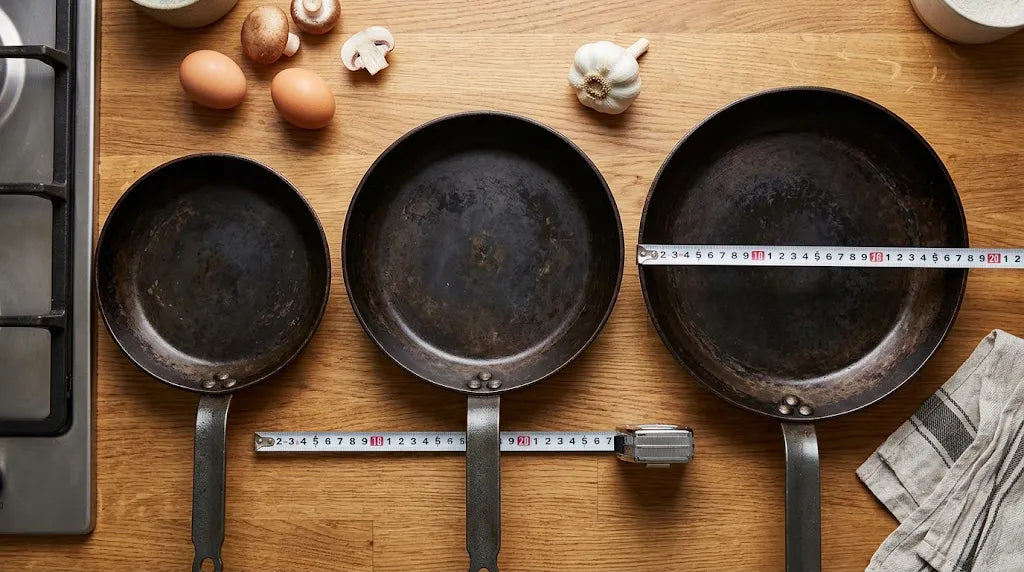
A frypan is the hardest-working pan in most kitchens, and the one people are most likely to buy twice. Sizes look like a small detail until you are trying to brown four chicken thighs in a pan that fits two. Here is what each size is actually good for, and how to choose without overthinking it.
WHAT FRYPAN SIZE ACTUALLY MEANS
Frypans are sold by their top diameter, measured across the rim in centimetres. That number is not the space you cook on. The flat base is always smaller, and sloped sides eat into the usable area. A 28cm frypan might give you 24cm to 25cm of flat surface.
When you compare pans, check the base diameter as well. It tells you how much food can sit flat and brown, and on an induction cooktop it decides whether the pan sits properly on the cooking zone.
THE COMMON SIZES
20cm: one or two eggs, a small omelette, a burger, toasting spices or nuts. Excellent as a second pan, frustrating as your only one.
24cm: two or three eggs, one or two chicken breasts, a meal for one or two people. A sensible starting size for a small household.
26cm: a middle size that suits two to three people. Less common in Australia than 24cm and 28cm, so matching lids and storage is a little harder.
28cm: the all-rounder. Three or four eggs, two steaks with room between them, a family stir-fry, most pancakes. If you buy one frypan, this is the size to buy.
30cm: large batches, broad fish fillets, four generous portions. Noticeably heavier and harder to store.
32cm: batch cooking and big family breakfasts. Worth it if you genuinely cook at that volume, awkward on a small hob.
WHY THE JUMP FROM 24CM TO 28CM MATTERS
It sounds like nothing. It is about a third more cooking surface, and surface area is what decides whether food browns or steams. Overlap your mushrooms and they release water instead of colouring. A pan that looks big enough on the shelf often is not once the food is in it.
HOW MANY PEOPLE YOU ARE FEEDING
One person: 24cm is comfortable. Add a 20cm later for eggs and sides.
Two people: 24cm for lighter meals, 28cm if you cook complete one-pan dinners.
Three or four: 28cm.
Five or more, or regular batch cooking: 30cm or 32cm, provided it fits your hob and your cupboard.
MATCH THE PAN TO YOUR HOB
On gas and electric, the pan should roughly sit within the burner or element, or overhang it only slightly. A pan much wider than the flame leaves the outer ring of food cooking slower than the middle.
Induction is where size gets strict. The base needs to cover the cooking zone's sensor, or the hob may not detect the pan, or will pulse on and off. A small pan on a large zone also heats unevenly. Measure your largest and smallest zones before you buy.
WEIGHT AND STORAGE
A 32cm cast iron frypan can weigh three kilograms or more empty, which matters when you are tipping out vegetables one-handed. Wider pans also have longer handles, so they claim more drawer or cupboard space. In a small kitchen, a 28cm plus a 20cm usually beats one oversized pan.
SIDE HEIGHT
Most frypans have sides between about four and seven centimetres. Shallow sides suit pancakes, eggs and searing, because steam escapes and food stays dry. Deeper sides hold a sauce or a stir-fry without throwing it over the rim, but they also trap moisture. If you cook a lot of saucy one-pan meals, look for a deeper frypan or a sauté pan rather than sizing up.
COATING AND MATERIAL
Size and material work together. Thin aluminium pans heat quickly but can warp and hotspot on high heat. Heavier forged or cast pans hold heat better, which suits searing and larger surface areas. Non-stick makes a big pan easier to handle for eggs and fish, but keep it to medium heat. Whatever the coating, an oversized pan on an undersized hob will always cook unevenly.
QUICK CHECKLIST
1. Count who you usually cook for, not who might visit.
2. Measure the flat base of your cooktop zones, especially on induction.
3. Measure your cupboard or drawer space, handle included.
4. Decide your main jobs: eggs and pancakes, searing, or saucy one-pan meals.
5. Lift the pan size you are considering while it is empty, and imagine it full.
6. Between sizes, cooking for two or more? Go larger.
7. Between sizes, cooking for one? Go smaller for easier handling.
8. If you can only buy one frypan, buy 28cm.
COMMON MISTAKES
Buying the largest pan that fits the shelf, then cooking small amounts in it. Thin layers of food dry out and burn at the edges.
Ignoring the base diameter, then wondering why an induction hob behaves oddly.
Assuming a bigger pan browns more food. Without enough heat and space between pieces, it browns less.
Buying a set of three pans in sizes that all overlap. Two well-chosen sizes beat three that do the same job.
WHAT ABOUT SQUARE AND GRILL PANS
Square pans and grill pans are also sold by width, but the measurement works differently. A square pan makes better use of a rectangular space and gives you more flat area for the same rim-to-rim size. A grill pan's ridges lift food off the surface, so you lose contact area and need a larger pan than you would for a flat one. Treat these as their own thing rather than comparing centimetres directly with a round frypan.
THE TWO-PAN APPROACH
Most kitchens are happiest with two frypans rather than one compromise: 28cm for the main cooking, and 20cm for eggs, sides and reheating. If you usually cook for one but batch cook now and then, 24cm plus 30cm covers both extremes.
A FINAL WORD
Buy for the meals you cook most weeks. A 28cm frypan handles the widest range of them, a 24cm feels lighter and quicker for one or two people, and anything bigger should earn its place by being used often enough to justify the space.