
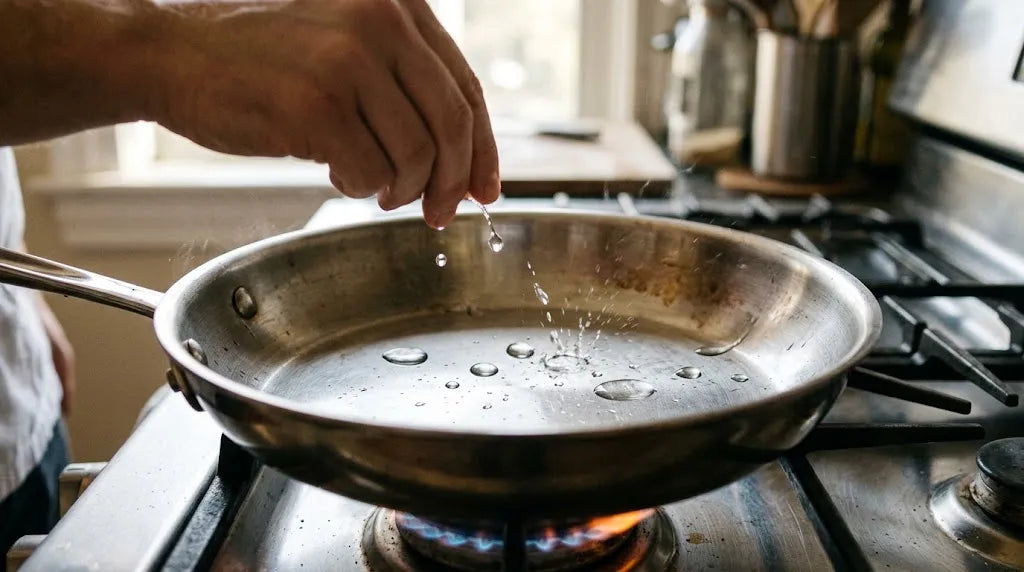
You don't need a chemical coating to stop food sticking to stainless steel. You need heat, timing and a thin film of oil. Get those three right and a stainless steel pan will release eggs, fish and steak as cleanly as any coated pan, and it will keep doing it for decades.
The mechanism behind this is a bit of physics called the Leidenfrost effect, and once you understand it, the whole thing stops feeling like luck.
Why Stainless Steel Sticks In The First Place
Stainless steel is not porous. Its surface is covered in microscopic peaks and valleys, and when the pan is cold those valleys give food proteins somewhere to grip. Heat the pan properly and two things change. The metal expands slightly, flattening the surface, and the moisture on the surface of your food flashes to steam the moment it touches the steel. That steam forms a thin cushion between the food and the pan. The food rides on the cushion instead of bonding to the metal.
That is the entire secret. It isn't a coating, a seasoning ritual or an expensive brand of cookware. It's temperature.
The Leidenfrost effect explains why water droplets can glide over a sufficiently hot surface on a layer of vapour.
The Water Test Is Your Real Temperature Gauge
Stove dials lie. A "6" on one cooktop is nothing like a "6" on another, so don't cook by the number. Cook by what the pan tells you.
Heat the empty pan over medium heat for two to three minutes, then flick a few drops of water onto the surface and watch what happens.
The water sizzles and vanishes straight away: too cold. Wait another 30 to 60 seconds and test again.
The water forms one or two round beads that skate across the surface like mercury: perfect. This is roughly 190°C to 230°C, the Leidenfrost zone.
The water splits into dozens of tiny droplets that scatter and jump: too hot. Slide the pan off the heat for 20 to 30 seconds, then retest.
Most people give up on stainless steel because they skip this step and add food to a lukewarm pan. If you only take one thing from this article, take the water test.
The Three-Step Method
Preheat the pan dry. No oil yet. Oil hides the surface and makes the water test useless, so get the metal to temperature first.
Add your fat once the bead is rolling. Wipe out any leftover water, pour in about a tablespoon of oil and swirl it around. It should shimmer and ripple within seconds. If it's smoking hard, the pan is too hot.
Add the food and leave it alone. This is the step that undoes the most good work. Food will stick for the first 30 to 90 seconds while it browns, and that's normal. Once a crust forms, it releases on its own. If you poke and flip too early, you tear the crust off and leave it stuck to the pan.
Let The Food Release Itself
Patience is a technique, not a personality trait. When a piece of protein is ready to turn, it tells you: it slides freely when you nudge it with tongs. If it resists, give it another 30 seconds. Chasing the food around the pan with a spatula is how people end up with shredded fish and scrubbing to do later.
The same applies to vegetables. Give them a moment to develop colour before you start tossing.
Choose An Oil That Can Take The Heat
A stainless steel pan runs hot, so use fat with a high smoke point.
Refined avocado, grapeseed, canola or rice bran oil all handle the Leidenfrost zone without burning.
Clarified butter or ghee works well and tastes better than neutral oil for eggs and fish.
Extra virgin olive oil and regular butter have low smoke points. They'll burn before the pan is ready, so save them for finishing or for lower-heat cooking.
You need far less oil than you think, just enough to coat the base in a thin sheen.
Can You Season A Stainless Steel Pan?
Not permanently, and anyone who tells you otherwise is thinking of cast iron. Cast iron and carbon steel are porous and reactive, so oil polymerises into the surface and builds up over time. Stainless steel is non-porous and non-reactive by design, so there's nothing for that layer to cling to. A thin oil film heated on the surface can make one cooking session feel slicker, but a soapy wash takes it straight off.
That's good news, not bad. It means your stainless steel pan doesn't need maintenance rituals, it needs good heat control. And you never have to worry about a coating flaking into your dinner.
FOUR MISTAKES THAT CAUSE STICKING
Adding food to a cold pan, which is the single most common cause.
Blasting the pan on high heat and overshooting the sweet spot, so the oil burns on contact.
Crowding the pan, which drops the temperature and turns your sear into a steam.
Moving the food too soon, before a crust has had time to form.
Quick Checklist
1. Put the clean, dry pan on medium heat for two to three minutes.
2. Flick a few water drops in and wait for the mercury-bead effect.
3. Wipe out any water and add a thin film of high-smoke-point oil.
4. Wait until the oil shimmers, roughly 15 to 30 seconds.
5. Lay the food in and don't touch it for 30 to 90 seconds.
6. Nudge it with tongs; flip only when it moves freely.
7. Adjust the heat down once the food is in, not up.
Keeping The Surface Ready For Next Time
Burnt-on residue and cloudy mineral stains can make the pan harder to use and clean. Wash the pan in warm soapy water once it has cooled, and for stubborn patches or rainbow heat tint, follow appropriate stainless steel cleaning techniques. A clean cooking surface is easier to maintain.
Avoid soaking the pan for hours, and never plunge a hot pan into cold water, as the sudden change in temperature can warp the base.
The Bottom Line
A stainless steel pan isn't naturally non-stick, and it isn't supposed to be. But it can behave like one every single time if you preheat it properly, add the right oil and give your food a moment to release. Master the water test and you'll stop reaching for the coated pan altogether.
If you're still comparing materials, our guide to stainless steel vs non-stick cookware explains the differences.