
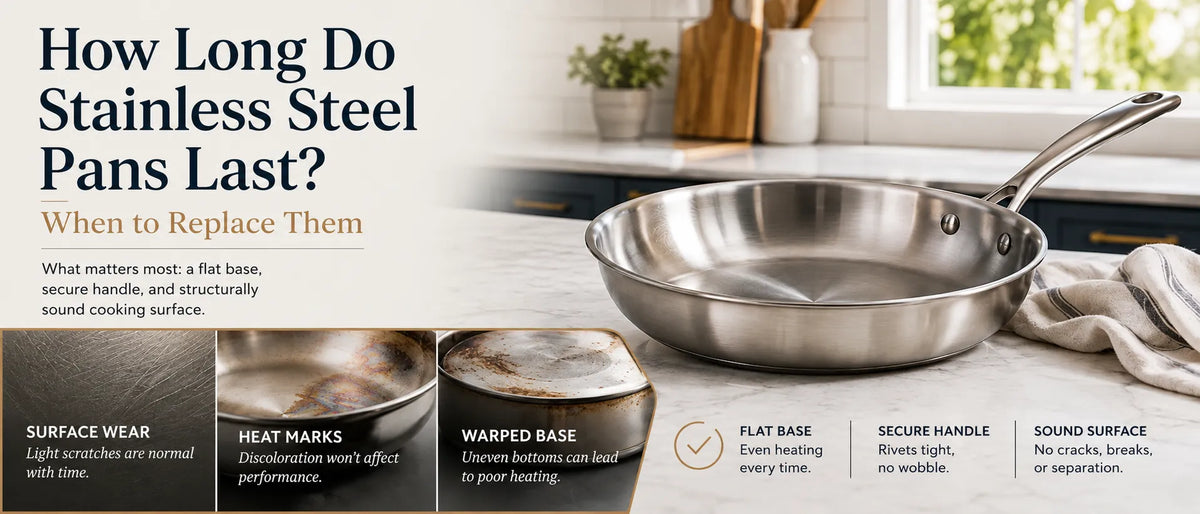
A good stainless steel pan can last for decades. There is no fixed expiry date, and the average lifespan depends on the pan's construction, how often you use it, the heat you cook with and how you clean it.
High-quality stainless steel cookware usually lasts much longer than coated cookware because there is no non-stick layer that has to remain intact. In many cases, light scratches, water spots and discolouration are cosmetic rather than signs that the pan has failed.
The important question is not simply how old the pan is. It is whether the base is still flat, the handle is secure and the cooking surface is structurally sound.
How Long Do Stainless Steel Pans Last?
For normal home use, a well-made stainless steel pan can remain useful for many years and often for decades. describes stainless steel cookware as strong, long-lasting and resistant to rusting and staining.
Lower-quality pots and pans may wear out sooner. Thin metal is more likely to warp after repeated overheating or sudden temperature changes. A bonded base can also become a weak point if it starts to separate.
Unlike many non-stick pans, stainless steel cookware does not depend on a surface coating for its basic cooking performance. That means a scratch does not automatically mean it is time to replace the pan.
Why Does Stainless Steel Cookware Last So Long?
Corrosion Resistance
Stainless steel contains chromium, which reacts with oxygen to form a thin protective layer on the metal. The Australian Stainless Steel Development Association's guide to corrosion resistance explains that this chromium oxide layer, known as the passive layer, forms quickly and can reform after minor surface damage.
This corrosion resistance is one reason grades such as 18/10 stainless steel are common in cookware. If you want to understand the material in more detail, Uncle Buffalo also covers the safety and properties of stainless steel cookware.
Strong, Layered Construction
The way a frying pan is built matters as much as the steel itself. Stainless steel does not spread heat as readily as aluminium, which is why many quality pans combine different metals. Measurements published by the National Institute of Standards and Technology illustrate the difference in thermal conductivity between stainless steel and aluminium.
Tri-ply cookware normally places an aluminium core between stainless steel layers. The core helps spread heat across the base and sides, while the stainless steel provides a durable cooking surface. Better heat distribution can also reduce local hot spots.
No Coating That Has to Survive
Non-stick cookware relies on its coating to provide easy food release. Once that coating is badly worn or damaged, the pan may no longer perform as intended.
Stainless steel works differently. The cooking surface is the metal itself. It may pick up fine scratches over time, but normal surface wear does not have the same effect as damage to a non-stick coating.
What Affects the Lifespan of a Stainless Steel Pan?
1. Build Quality
A heavy, well-made pan will usually handle years of heating and cooling better than a very thin one. Look for a flat base, solid handles and even construction.
Fully clad or tri-ply pans can also spread heat more evenly across the cooking surface. If you use a pan often, that extra stability can help with long-term durability.
2. Stainless Steel Grade
Grades such as 18/10 stainless steel are widely used for cooking surfaces. Chromium supports corrosion resistance, while nickel can improve stability and finish.
If you cook on induction, check the product specifications rather than assuming every stainless steel pan will work. NYSERDA's induction cooking guide notes that induction needs suitable magnetic cookware, and only some types of stainless steel are compatible.
3. Heat and Temperature Control
Stainless steel can handle high temperatures, but constant maximum heat is rarely needed for home cooking. Preheating gradually and using medium heat for many cooking techniques gives you better temperature control.
Practical guidance from worldstainless on cooking with stainless steel frying pans also recommends preheating before adding food and warns that severe thermal shock can increase the chance of warping.
Overheating can cause rainbow discolouration and, in a thin pan, may contribute to warping. The bigger risk is sudden thermal shock, such as running cold water into a very hot frying pan.
If sticking is the problem rather than durability, Uncle Buffalo's guide explains how to use heat when cooking with stainless steel.
4. Cleaning and Storage
Stainless steel is low maintenance, but harsh treatment can shorten its useful life. The British Stainless Steel Association's cleaning guidance warns that chloride-containing cleaners and concentrated bleach can cause staining and pitting.
How you store cookware matters too. Stacking pots and pans without a separator can create scratches and dents. These marks are often cosmetic, but careful storage keeps the cookware in better condition.
When Should You Replace a Stainless Steel Pan?
Age alone is not a reason to throw away a pan. Replace it when damage affects safety, stability or cooking performance.
Severe Warping
Place the pan on a flat surface. If it rocks, spins or no longer sits evenly, the base may be warped.
A small amount of movement may not matter on a gas hob, but severe warping can be frustrating on glass, ceramic or induction cooktops. It can also cause oil to gather around the edge instead of staying evenly across the cooking surface.
If gas is your main heat source, Uncle Buffalo's guide to choosing fry pans for a gas stove explains some of the features worth considering.
Layers or Base Separating
A multi-layer pan should remain firmly bonded. If you can see the layers splitting around the rim, or a bonded base is pulling away from the pan, stop using it.
Separation can cause uneven heating and is a structural problem rather than a cosmetic one.
Loose or Damaged Handles
A handle that moves slightly may sometimes be repairable. A cracked attachment point, broken rivet or handle that cannot safely support a full pan is different.
If you cannot lift the cookware confidently when it contains hot food or liquid, it is time to repair or replace it.
Deep Pitting or Serious Corrosion
Pitting looks like small holes or craters in the cooking surface. A few tiny marks may have little effect on everyday use, but deep or widespread pitting can make the surface harder to clean.
Salt is a common cause. Clemson University's cookware safety guidance notes that undissolved salt can pit stainless steel surfaces. Add salt after the water has started boiling and stir it in rather than leaving crystals sitting on the bottom of a stainless steel pot.
Do Scratches Mean a Stainless Steel Pan Is Ruined?
Usually not. Fine scratches are a normal part of using stainless steel pans. Metal utensils, cleaning and stacking can all leave visible marks.
If the pan is still flat, heats evenly and has no structural damage, light scratching is normally a cosmetic issue. A deep gouge that exposes or separates a bonded layer is different and deserves closer inspection.
Uncle Buffalo's guide to scratches on stainless steel cookware goes into more detail about normal wear and how to care for a scratched surface.
How to Make Stainless Steel Pans Last Longer
Let the Pan Cool Before Washing
Do not take a very hot pan from the hob and place it under cold running water. The sudden temperature change can stress the metal and increase the chance of warping.
Let the pan cool until it is safe to handle, then wash it in warm water. Hand washing with mild detergent and a soft sponge is a gentle option, even when the pan is labelled dishwasher safe.
Use Sensible Heat
Good heat control protects the pan and makes cooking easier. For sautéing, browning and most everyday cooking, start by preheating the pan gradually rather than turning the burner straight to high.
A properly heated stainless steel pan can release food well when you use the right amount of oil and allow the food to brown before moving it.
Clean Stains Gently
For normal washing, use a soft or non-abrasive sponge. Avoid chlorine bleach and other cleaners that are not recommended for stainless steel.
For stuck food, warm water and baking soda can help loosen residue. White vinegar is useful for light water spots or rainbow discolouration. Rinse the pan well afterwards and dry it to reduce marks.
Research reviewed by the UK Food Standards Agency also identifies stainless steel as one of the easier food-contact surfaces to clean.
Store Cookware Carefully
If you stack your cookware, place a cloth or pan protector between pieces. This limits scratching and helps protect rims and handles.
You do not need to keep a working pan looking perfect. The goal is to prevent dents, handle damage and other problems that affect the way it cooks.
Stainless Steel Compared With Other Cookware
Stainless Steel vs Non-Stick
Non-stick pans are convenient for eggs and other delicate foods, but their lifespan depends heavily on the condition of the coating. Stainless steel has no comparable coating to wear away.
The better option depends on what you cook and how much maintenance you want. If you regularly switch between pan styles, understanding the different cooking techniques is more useful than expecting one material to handle every job.
Stainless Steel vs Cast Iron
Cast iron can also last for generations. It retains heat well and works well for many high-heat cooking jobs.
The main difference is care. Cast iron needs seasoning and careful drying to control rust. Stainless steel requires less surface maintenance and is convenient for acidic dishes that contain tomato, wine or lemon juice.
Both can be durable choices. The right one depends on the dishes you cook most often.
Frying Pan vs Sauté Pan
Material is only part of choosing cookware. Shape also changes how a pan performs. A frying pan has sloping sides that make tossing and turning food easy, while a sauté pan has straighter sides that hold more liquid.
Uncle Buffalo's fry pan vs sauté pan guide can help if you are deciding which shape suits your cooking style.
Is Expensive Stainless Steel Cookware Worth It?
Price is not a guarantee of lifespan. What matters is the construction you are paying for.
A better pan may use thicker material, a tri-ply or multi-layer body, a flat induction-ready base and stronger handles. Those details can improve cooking performance as well as durability.
Think about how you cook before paying for extra features. If you move cookware from hob to oven, check that the pan and handles are oven-safe. If you use gas, a stable base and even heat distribution may matter more than a polished finish.
You can also compare the types of construction available across Uncle Buffalo's Buffalo cookware range before deciding what suits your kitchen.
The best value is a pan that suits your cooking style, is built well and can be maintained without fuss.
Final Verdict: Keep It or Replace It?
Keep your stainless steel pan if it has light scratches, stains or minor discolouration but still sits flat, heats evenly and has a secure handle. Most cosmetic marks do not stop the pan from doing its job.
Replace or repair it if the base is badly warped, the bonded layers are separating, the handle is unsafe or the cooking surface has serious structural damage.
With sensible heat, regular cleaning and basic care, stainless steel cookware can be a long-term part of your kitchen. If you are ready to replace a damaged pan or upgrade your cookware, explore Uncle Buffalo's stainless steel cookware range for options made for everyday cooking.