
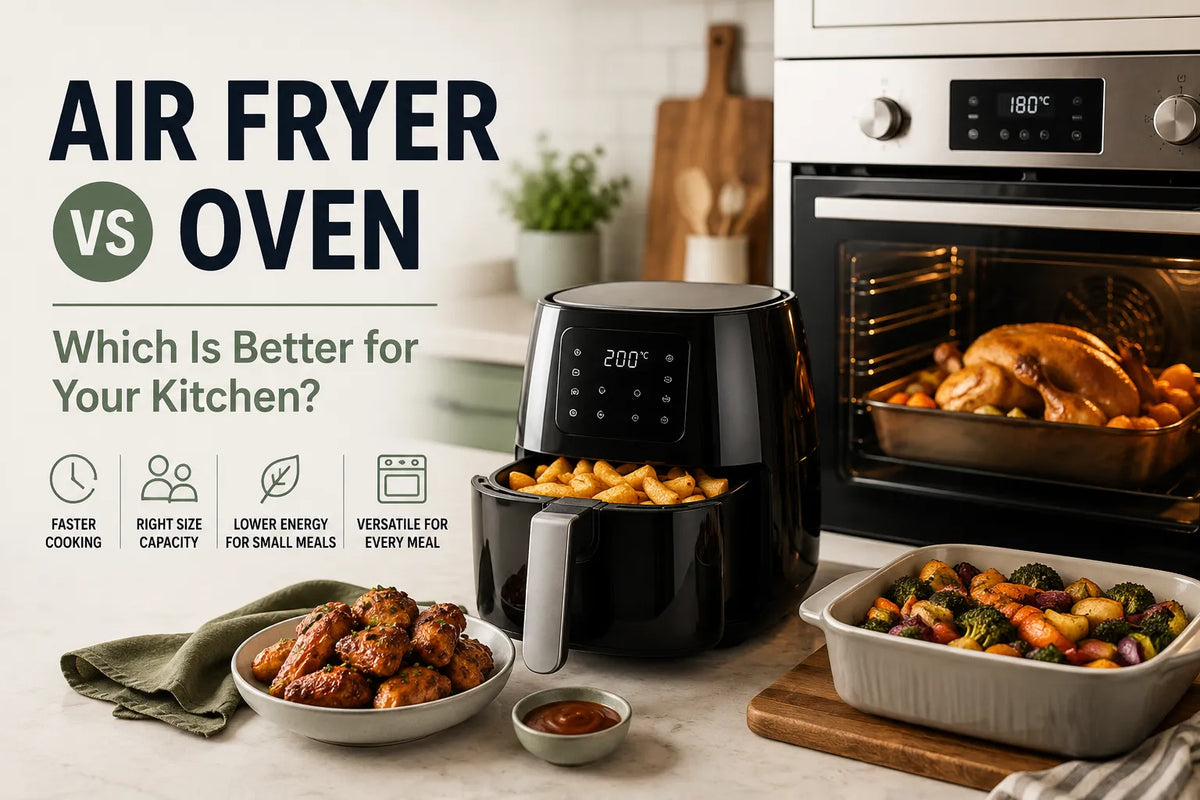
Choosing between an air fryer and an oven comes down to how you cook. An air fryer is usually quicker for smaller meals, while an oven gives you more room for family dinners, large dishes and batch cooking.
Both have a place in the kitchen. The better option depends on your household size, what you cook most often and whether speed, capacity or versatility matters more to you.
Running costs can also influence the decision. Independent testing from CHOICE comparing air fryers and ovens found that the more economical option can depend on what you are cooking and how much food you need to prepare.
What Is the Main Difference?
An air fryer is a compact kitchen appliance that uses a heating element and a strong fan to move hot air around food. Because the cooking chamber is small, heat stays close to the food and moisture escapes quickly. This helps create a crisp surface without having to submerge food in oil.
Deep frying works differently because the food cooks directly in hot oil. Air frying can give foods such as chips and chicken wings a similar crisp finish while using less oil, although the texture will not be exactly the same.
A traditional electric oven has a much larger cavity. Standard ovens heat the space with heating elements, while a convection oven uses a fan to move hot air around the cavity.
A fan-forced oven therefore works on a similar principle to an air fryer, but it has much more space to heat. Australian Government energy advice notes that fan-forced ovens circulate heat more evenly and can cook food faster than conventional models. See the Australian Government's appliance energy advice
That difference in size and airflow affects cooking time, browning, capacity and energy use.
If the material inside the appliance also matters to you, Uncle Buffalo's PureSteel stainless steel air fryer is one example of a drawer-style model with a stainless steel interior.
Key Differences at a Glance
|
Feature |
Air Fryer |
Oven |
|
Cooking time |
Usually quicker for smaller portions |
Better suited to large meals and batches |
|
Preheating |
Short, and sometimes not required |
Usually takes longer |
|
Capacity |
Best for small to medium portions |
Handles larger dishes and multiple trays |
|
Crispiness |
Excellent for chips, crumbed food and chicken wings |
Good, especially with fan-forced settings |
|
Baking |
Useful for small items |
Better for cakes, bread and larger batches |
|
Energy use |
Often lower for small meals |
Can make more sense for large quantities |
|
Reheating |
Fast for foods that should stay crisp |
Useful but slower for small serves |
1. Cooking Speed and Preheating Time
For a quick dinner, the air fryer often has the edge. Its compact chamber heats quickly, so preheating times are generally short. Some recipes do not require preheating at all.
An oven needs to warm a much larger space. That can add extra time before cooking begins, although the exact preheat time depends on the model, temperature and setting.
Cooking time also depends on the food and portion size. Small amounts of chips, fish, roast veggies or chicken pieces can cook quickly in an air fryer. A large tray bake or family meal may be easier in an oven because everything can cook in one go.
For example, smaller portions such as salmon fillets work particularly well in an air fryer. Uncle Buffalo also has an air fryer salmon teriyaki recipe if you want an example of how this type of meal can be prepared.
If you have to cook three or four air fryer batches, however, the time advantage becomes much smaller.
2. Capacity and Portion Size
This is where an oven has a clear advantage.
A drawer-style air fryer works best when food has enough room around it for hot air to circulate. If you pack the basket too tightly, airflow can be restricted and the food may steam rather than develop the crispiness you want.
That makes an air fryer convenient for smaller meals, side dishes, snacks and quick weeknight cooking. Larger models offer more capacity, but there is still a practical limit.
An oven can handle a large baking dish, family-sized meal or several trays at once. It is also more practical for casseroles, large cuts of meat and batch cooking.
Choosing an appliance that suits the size of your household can also affect long-term running costs. Australia's YourHome guide recommends considering the right appliance size for your household rather than simply buying the largest model available. Read YourHome's appliance efficiency guide
If you regularly cook for a crowd, the extra oven space is difficult to replace.
3. Crispiness and Even Browning
A crisp finish is one of the main reasons people reach for an air fryer.
Fast-moving hot air dries the surface of food quickly, making the appliance particularly useful for chips, crumbed foods, roasted veggies and chicken wings.
For even browning, avoid overcrowding the basket. Shaking the basket or turning larger pieces partway through cooking can also help expose more of the food to circulating air.
A fan-forced oven can still produce crisp food, especially when ingredients are spread across a tray. The difference is that the airflow is less concentrated because the cavity is much larger.
Roasting is also an effective way to bring out the natural sweetness and caramelisation in vegetables. Health and Wellbeing Queensland provides useful guidance on roasting vegetables and other basic cooking techniques.
If you want some inspiration for foods that work well with concentrated hot air, you can also browse Uncle Buffalo's air fryer recipes.
4. Energy Consumption and Running Costs
For smaller meals, an air fryer can be more energy efficient because it heats a smaller space and often runs for a shorter period.
That can reduce energy consumption for everyday jobs such as cooking a few portions or reheating leftovers.
Australian Government guidance specifically suggests considering smaller appliances such as an air fryer, microwave or slow cooker because they can be quicker and more energy efficient than switching on a full oven for some cooking tasks. See energy-saving advice for kitchen appliances
However, electricity use varies between appliances. The final electricity cost depends on the appliance's wattage, the temperature, cooking time and your electricity tariff.
A full-sized oven may use more power while it is running, but it can cook much more food in one cycle. If you need several air fryer batches to make dinner, the gap in running costs can narrow.
This is why it is better to compare the amount of food you are cooking rather than assume one appliance will always cost less to run.
Other kitchen appliances may also make more sense for certain jobs. A microwave can be practical for simple reheating, a slow cooker works well for long, low-temperature meals, and an efficient cooktop may be the better choice for a small saucepan or frying pan.
If reducing electricity bills is a priority, use the smallest practical appliance for the job without creating extra batches or unnecessary cooking time.
5. Baking, Roasting and Grilling
An oven remains the more versatile option when you need space.
For baking, it can hold larger tins and several trays. Cakes, bread and biscuits also benefit from the steady heat of a full-sized oven. An air fryer can still handle smaller baked items, such as muffins or pastries, provided the cookware fits safely inside.
For roasting, an air fryer works well with smaller portions of potatoes, vegetables or meat. The oven is more practical for a large chicken, bigger cuts of meat or a full tray of food.
Grilling is another factor to consider. Many ovens include a dedicated grill function for browning and finishing dishes. Some air fryers also include grilling modes, but the available functions depend on the model.
Better Health Channel recommends cooking methods such as baking, grilling, steaming and microwaving as alternatives to deep frying when trying to reduce the amount of fat used in cooking. Read its healthy cooking tips
Some air fryers also offer dehydrating functions for foods such as fruit and vegetables. An oven can sometimes be used for low-temperature dehydrating too, but its larger cavity may make it less practical for a small quantity.
6. Reheating Leftovers
One area where an air fryer is especially handy is reheating leftovers that should stay crisp.
Pizza, chips, crumbed chicken and roast vegetables can soften in a microwave. Moving hot air can warm these foods while drying the surface, helping to bring some of the original texture back.
For soups, rice, pasta and saucy meals, however, a microwave or cooktop may be quicker and more practical.
Whichever appliance you use, food safety still matters when reheating previously cooked meals. Food Standards Australia New Zealand advises reheating potentially hazardous food quickly and avoiding repeated cycles of heating and cooling. See the FSANZ guidance on cooling and reheating food
Is Air Frying Healthier Than Oven Cooking?
Air fryers are often promoted as a healthier alternative to deep frying because they can create a crisp texture with much less oil.
That distinction is important.
When food is deep-fried, it is submerged in cooking oil. An air fryer relies mostly on circulating hot air, so many foods only need a light coating of oil, or no added oil at all.
Australian dietary guidance recommends alternatives such as roasting instead of deep frying and suggests using small amounts of unsaturated oil when cooking. See Eat for Health's low-fat cooking techniques
Compared with oven cooking, however, the health difference is much smaller. You can bake or roast food in a conventional oven with very little oil as well.
The Heart Foundation also recommends limiting deep-fried foods and choosing healthier oils suited to the cooking method. Read the Heart Foundation's advice on fats and oils
So an air fryer does not automatically make a meal healthier. What you cook, the portion size and the amount and type of oil you use matter more.
Its main advantage is that it gives you another way to prepare crisp food without relying on deep frying.
When an Air Fryer Makes More Sense
An air fryer may suit you if you:
-
Usually prepare small to medium meals.
-
Want shorter cooking and preheating times.
-
Like crisp foods, roast vegetables and quick snacks.
-
Often reheat leftovers.
-
Want to avoid heating a full-sized oven for a small amount of food.
-
Have enough benchtop space for another kitchen appliance.
-
Want additional functions such as roasting, grilling or dehydrating.
It can also be convenient in warm weather because you are heating a smaller cooking chamber rather than a full oven.
When an Oven Makes More Sense
An oven may be the better fit if you:
-
Regularly cook for a family or group.
-
Need room for large dishes and casseroles.
-
Do a lot of baking.
-
Want to prepare several foods at once.
-
Use large trays, cookware or baking dishes.
-
Frequently batch-cook meals.
If you already own a good convection oven or fan-forced oven, it may cover many of the same cooking jobs as an air fryer. The main trade-off is that you are heating a larger space.
Air Fryer vs Oven: Which Should You Choose?
There is no single winner.
Choose an air fryer if you mainly prepare smaller meals and value speed, crisp results and potentially lower energy use for those jobs.
Choose an oven if you need more capacity, regularly cook large meals or want the flexibility to bake and prepare several dishes at once.
For many households, the two appliances work best together. Use the air fryer for quick weeknight meals and small portions, then use the oven when you need more space.
If you decide an air fryer suits your routine, look beyond the preset buttons. Compare the capacity, power, temperature range, basket material and cleaning requirements. You can also read our guide to choosing a stainless steel inner bowl air fryer before deciding which design suits your kitchen.
Ready to compare your options? Explore Uncle Buffalo's air fryer range for air fryers designed for convenient everyday cooking.